
Reference
Quordle Glossary
Quordle has a small vocabulary of its own. Terms like candidate word, quartered keyboard, seed word, and letter coverage all describe different parts of the same four-board puzzle, and this page defines every one of them.
Quordle scores every guess against four separate five-letter answers at once, and the standard Classic mode gives you nine shared guesses to solve them. If the basic rules are still unclear, start with how to play Quordle instead.
Answer
One of the four hidden five-letter words you must solve. A standard Quordle game contains four separate answers.
Answer List
The pool of words the game can select as hidden answers. It’s normally smaller and more familiar than the full valid-guess list. A word can be accepted as a guess without ever being chosen as an answer.
Attempt
One submitted five-letter guess. Because the same guess enters all four boards at once, it counts as a single attempt rather than four.
Board
One of the four word grids. Each board has its own hidden answer and scores every guess independently.
Board Position
Where a board sits on screen: top-left, top-right, bottom-left, or bottom-right. Position identifies a board. It says nothing about how hard that board is.
Candidate Word
A possible answer that matches every green, yellow, and gray clue shown so far on a board. If _ R A _ E is confirmed with several letters ruled out, words like CRATE, GRAPE, or FRAME may remain as candidates depending on the yellow and gray clues.
Classic Mode
The standard Quordle format. Four boards, nine shared guesses, and every guess scores against all four boards at once.
Color Clue
The green, yellow, or gray feedback given to a letter after a guess. The same letter can receive different colors on different boards, since every board hides a different answer.
Coverage Word
A guess chosen to test several unused letters rather than solve one board immediately. A strong coverage word usually contains five different letters and is most useful early. Late in the game, most remaining guesses need to be realistic answers instead.
Cross-Board Thinking
A strategy of choosing a guess based on how it helps every unsolved board, rather than focusing only on the board closest to completion. It’s a core adjustment for players coming over from Wordle.
Daily Quordle
The standard puzzle Merriam-Webster releases once per day. Players solving the same puzzle number get the same four answers. This differs from practice and unlimited formats, which generate additional games on demand. Playing Quordle here uses an unlimited format rather than limiting you to one game per day.
Duplicate Letter
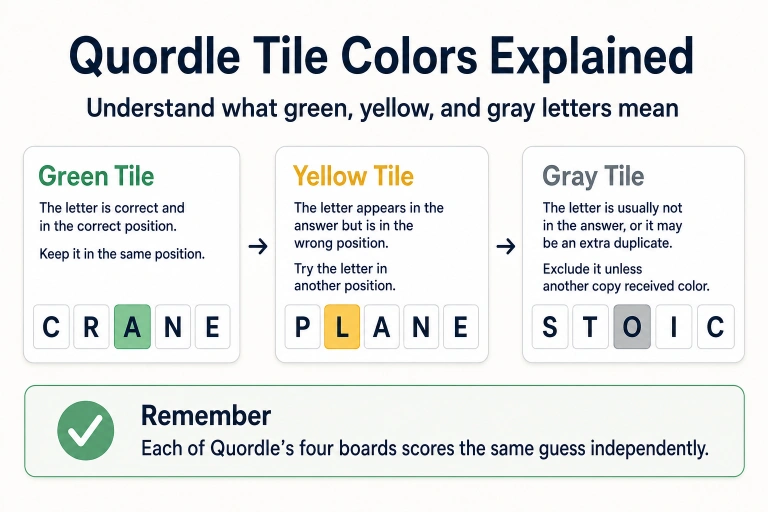
A letter appearing more than once in a guess or answer, like the two E’s in GEESE or the two L’s in BELLE. Quordle awards exact green matches first, then hands out yellow only for copies still remaining in the answer. Extra copies beyond that turn gray, even though the letter genuinely appears in the word.
Elimination Guess
A word played mainly to separate several similar candidate answers. If CATCH, HATCH, MATCH, PATCH, and WATCH all remain possible, a carefully chosen elimination word can test several of their opening letters at once.
Extreme Mode
A harder variant that gives you eight guesses instead of nine and draws from a more unusual word list. It keeps the standard four-board format, with every guess still scored across all four boards at once.
Feedback
The full set of color clues produced after a guess. Since every board scores independently, one guess produces four separate sets of feedback.
Gray Tile
Usually means the letter doesn’t appear in that board’s answer. The exception: if your guess has more copies of a letter than the answer actually contains, the extra copies turn gray even though the letter exists elsewhere in the word.
Green Tile
A letter confirmed in its exact position. Green status only applies to that one board. The same letter can be yellow or gray on the other three.
Guess
Any valid five-letter word you submit. A guess can function as an attempted answer, an information word, or an elimination word depending on when and why you play it.
Hidden Word
Another name for an answer that hasn’t been solved yet. Every game starts with four hidden words.
Hint
A clue given without requiring a full guess, such as an opening letter, a definition, a vowel count, or a note about a repeated letter. A hint isn’t the same as feedback, since feedback only comes from a word you actually submit.
Information Guess
A word chosen for how much new information it reveals across the unsolved boards, usually by testing unused letters or repositioning yellow ones. The Quordle strategy guide covers when to stop gathering information and start committing to answers.
Keyboard
The on-screen or physical keys used to enter guesses. Quordle’s on-screen keyboard also tracks the status of every letter you’ve already tested.
Letter Coverage
How many different letters one guess, or a group of guesses, actually tests. CRANE and PILOT together give ten-letter coverage because the two words share no letters. Repeating letters lowers coverage, though it can still be worthwhile when testing a likely answer.
Letter Position
A letter’s numbered place inside a five-letter word: first, second, middle, fourth, or final. Green confirms both the letter and its position. Yellow confirms the letter but rules out the position you tried.
Letter Status
Everything currently known about a specific letter on one board. Status can be untested, gray, yellow, green, or flagged as possibly repeated.
Mode
A version of the game with adjusted rules. Classic, Chill, Extreme, Sequence, and Rescue are all modes. The game modes overview breaks down how each one actually plays differently.
Multi-Board Word Game
Any word puzzle where one guess affects several answer grids at once. Quordle uses four boards; other games in this family use more or fewer. The games like Quordle page compares the main formats.
Opener
The first word entered in a game. See also Starting Word, which refers to the same thing. A strong opener tests common vowels and consonants without repeating letters. The best Quordle starting words page compares practical choices.
Pattern
The known letter structure of a partially solved word, often written with underscores for unknown letters, like S_A_E. Patterns become genuinely useful once green positions are locked in and yellow letters narrow down what can fill the gaps.
Practice Mode
A non-daily format that allows repeated games, used for testing openers, learning the color system, or practicing without touching your daily result.
Probe Word
See Information Guess and Elimination Guess. A probe word is either one, played to test uncertain letters rather than attempt the most likely answer.
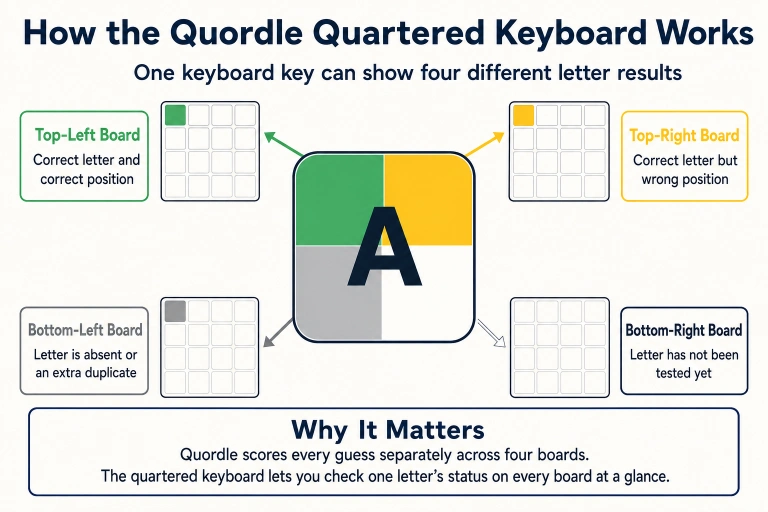
Quadrant
One of the four small sections inside a keyboard key. Each quadrant shows that letter’s status on one specific board.
Quartered Keyboard
A keyboard where every key is split into four status sections, one per board. It lets you check how a single letter scored across all four boards without rereading every grid.
Remaining Candidates
The words still capable of being the answer once every known clue is applied. A good guess shrinks this list. A Quordle solver does this filtering automatically once you enter the correct colors.
Rescue Mode
A mode where the computer fills in the first two words for you before you start, and you get seven total guesses to recover and solve all four. It’s harder than it sounds, since the computer’s picks aren’t chosen to help you.
Repeated Letter
See Duplicate Letter. Repeated letter usually describes a letter appearing more than once in the answer itself, rather than in your guess.
Seed Word
A planned opening word used at the start of the information-gathering phase. Some players use one seed word; others use a small set with little or no letter overlap. This is a strategy term, not something the game itself labels.
Sequence Mode
A mode where you solve the four answers one at a time in a fixed order, moving to the next word only once the current one is solved. It typically runs longer than Classic, giving you extra guesses to account for the added structure.
Share Grid
The colored square pattern generated after finishing a puzzle, showing how the game went without revealing any actual letters or answers.
Solved Board
A board whose answer you’ve correctly guessed. All five tiles in that row turn green, and future guesses should shift focus to whatever boards remain open.
Solver
A tool that filters possible words using the colors already shown in your game. A solver never sees the hidden answer; it only returns words consistent with the clues you feed it, so wrong input produces wrong candidates.
Starting Word
See Opener. Refers specifically to the first guess of a game.
Streak
The number of consecutive games you’ve won. A loss typically ends the current streak, though missed days, cleared browser data, or switching devices can affect how a streak is tracked depending on the version you’re playing.
Tile
One letter square inside a board. Each five-letter guess creates a row of five tiles.
Triplet Method
An opening strategy using three words with no repeated letters between them. A clean triplet tests exactly fifteen different letters across the first three guesses, trading three guesses for information before you try to solve anything.
Unsolved Board
Any board whose answer hasn’t been found yet. Late in the game, prioritize whichever unsolved board has the least useful information, since it’s the one most likely to run out the clock.
Valid Answer
A word eligible to be selected as one of the hidden solutions. Every valid answer is also a valid guess, but not every valid guess belongs to the answer pool.
Valid Guess
A five-letter word the game’s dictionary recognizes and accepts as input. Abbreviations, proper nouns, random letter strings, and words missing from the dictionary get rejected. The Quordle word list page explains the difference between accepted guesses and possible answers in full.
Vowel Coverage
How many different vowels a guess or opening sequence tests, focused on A, E, I, O, and U. Testing every vowel helps, but consonant coverage matters just as much since most five-letter words lean more heavily on consonants.
Win Rate
The percentage of your recorded games that ended in a win, calculated by dividing games won by games played and multiplying the result by 100.
Word List
The dictionary used to validate guesses and select answers. It typically contains two separate pools: the words accepted as guesses, and the smaller set of words eligible as hidden answers.
Yellow Tile
A letter that’s in the answer but currently sitting in the wrong position. Try it somewhere else on your next guess for that board. Classic mode doesn’t force you to reuse it immediately, though doing so is usually good strategy. If it turns yellow again in a new spot, both tested positions are now excluded.
Frequently Asked Questions
Does a gray letter always mean it’s not in the word?
No. Gray usually means the letter is absent, but an extra copy can turn gray when the answer contains fewer copies of that letter than your guess does.
Can a letter be gray on one board and green on another?
Yes. Each board has a different hidden answer and scores the same guess independently. A letter can be green, yellow, or gray in different keyboard quadrants at the same time.
Is every five-letter English word accepted in Quordle?
No. A guess has to exist in the specific dictionary that version of Quordle uses. Some real words, proper nouns, abbreviations, and uncommon forms get rejected.
What’s the difference between a valid guess and a possible answer?
A valid guess is any word the game accepts as input. A possible answer belongs to the smaller pool the game actually draws hidden words from.
Is it spelled gray tile or grey tile?
Both refer to the same thing. Gray is the standard American spelling, and grey is more common in British English.
Are all these Quordle terms official?
No. Board, guess, tile, and color feedback describe the actual interface and rules. Terms like seed word, probe word, candidate, and triplet method come from player strategy discussions, not the game itself.
Ready to put these terms to use?
Four boards, one keyboard, nine guesses.
Quordle Terms, Explained Simply
Word games generate their own vocabulary, and Quordle has plenty of it. This glossary collects the terms you will see across the game and this site (board, tile, streak, shared guess) in plain language, no jargon required.
The essentials
- Board: one of the four grids; each hides its own five-letter word.
- Tile: a single letter square. Green: right letter, right spot. Yellow: in the word, wrong spot. Gray: not in that word.
- Shared guess: one typed word counted on every board at once.
- Daily challenge: the same four words for all players, resetting at midnight.
- Streak: consecutive days with at least one solved puzzle.
Use the checker above to confirm any word before you play, and see the valid words guide for why some real words still get rejected.